
Breaking News
 July 3
byNoah Grayson
An active-duty US Air Force major, Jason Watson, was arrested at the US Capitol after staging a protest calling for President Donald Trump’s impeachment, prompting a military investigation
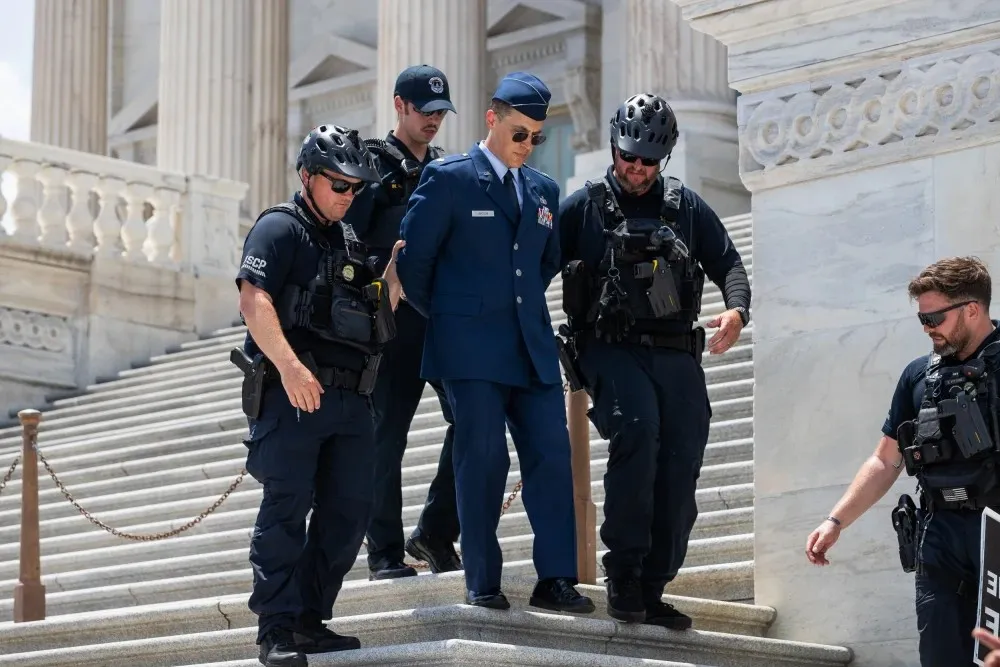
An active duty US Air Force major was arrested outside the US Capitol after staging a one-man protest for the impeachment, conviction and removal of President Donald Trump, officials and multiple reports said. Major Jason Watson, the officer who stood on the steps of the Capitol holding a sign calling for Trump’s impeachment, was arrested by Capitol Police. Witnesses’ footage and reports show that he was wearing his uniform at the time of the demonstration, which took place in a restricted area where protests are banned. The incident prompted an immediate review by the US Air Force, which confirmed it is launching an investigation into the officer’s conduct under military regulations governing political activity by service members.
Watson was reportedly alone on the steps of the Capitol calling for the president’s removal with a sign that read variations of “Impeach, Convict, Remove,” according to several outlets. He was detained by Capitol Police shortly after the demonstration began. The arrest happened in a region with increased security restrictions, where no unauthorised protests are allowed. Video of the incident showed officers escorting Watson away as he remained calm and did not resist arrest, and the video circulated widely online.
The US Air Force said it was reviewing the incident and stressed the importance of the military's nonpartisan status. Military law strictly limits political speech for those on active duty, especially in uniform. Article 88 of the Uniform Code of Military Justice bars officers from contemptuously speaking about the president, vice president and Congress. Officials said the investigation would follow standard disciplinary procedures to determine whether Watson violated those rules.
The case underscores long-standing prohibitions on political activity by members of the U.S. armed forces. Although service members do not surrender their First Amendment rights, those rights are limited in ways that could compromise the military’s perceived neutrality. Participation in political demonstrations in uniform is generally forbidden, particularly if they involve direct appeals for the removal of civilian leadership. Those cases are generally handled internally unless other charges are brought, say legal experts, and punishment can range from a reprimand to administrative separation depending on the findings.
The arrest comes amid rising political tensions in Washington, where there are ongoing arguments over demonstrations against the country’s top political leaders and the policies they pursue. Watson’s demonstration has been cited in broader debates about the dividing lines between personal political speech and professional military obligations, especially in an era of growing public protests near federal buildings. Supporters of Watson’s actions have claimed the protest was an act of conscience, while critics have said it undermines military discipline and the apolitical nature of the armed forces.
Major Watson is still under investigation at this time and there has been no disciplinary outcome announced by the Air Force. Officials said the case would be reviewed thoroughly to determine whether his actions violated military law and whether any further administrative or legal action would be taken. The incident is expected to remain under scrutiny as it raises broader questions about political expression, civil disobedience and the limits of free speech within the US military structure.

Noah Grayson is a U.S. daily news reporter covering national stories, breaking events, and human-interest developments.
 Newsflash: