Midcycle Redistricting Shifts the 2026 House Battlefield
Ten states adopted new congressional maps ahead of the 2026 midterms after a rare wave of mid-decade redistricting.

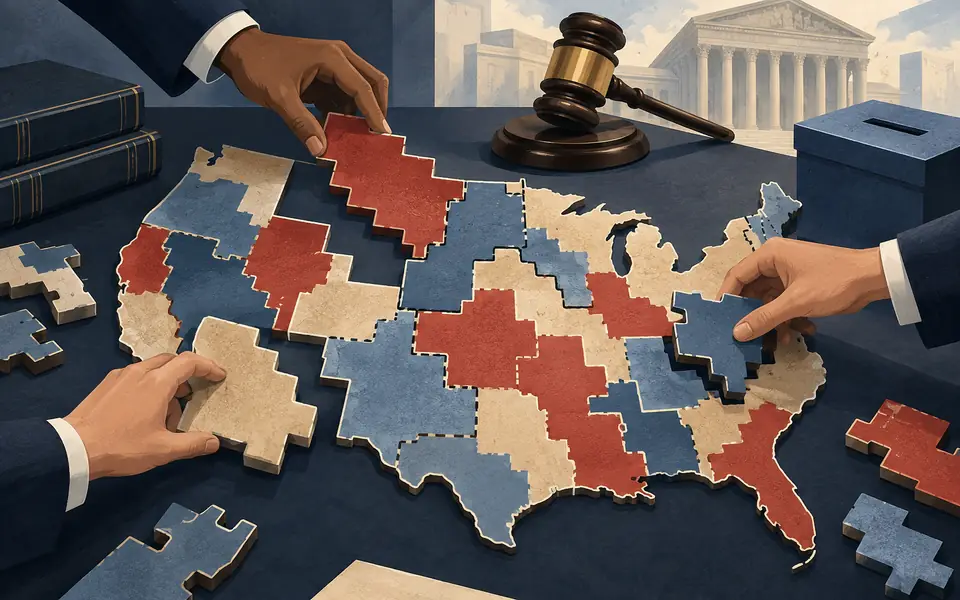
Ten states adopted new congressional maps ahead of the 2026 midterms after a rare wave of mid-decade redistricting. Estimates of partisan gains describe how many districts became more favorable on paper; they do not guarantee election outcomes, which will also depend on candidates, turnout and the national political environment.
The numbers behind the fight are genuinely consequential. After ten states enacted new congressional maps over the past year, Republicans are positioned to pick up as many as 16 favorable seats this fall, compared with roughly six for Democrats, a gap that could prove decisive in a House currently split along razor-thin margins.
Texas and California map changes
Texas kicked off this cycle's fight after Trump suggested in mid-2025 that the state redraw its congressional map for Republican advantage, a plan that ultimately aimed to net the GOP five additional House seats. Texas Democrats initially tried to slow the process by repeatedly denying the legislature the quorum needed to hold a vote, but Republican Governor Greg Abbott eventually signed the new map into law.
California answered almost immediately. Encouraged by Governor Gavin Newsom, state Democrats advanced their own ballot measure designed to offset the GOP's expected gains by slashing Republican-held House seats in the deeply blue state, sending the question directly to California voters in a special election that November. Missouri followed Texas's lead on the Republican side, while additional states on both sides entered the fray as the year went on.
How court decisions changed the map
Just as Democrats appeared to have clawed the national picture back to roughly even by drawing enough favorable seats of their own, the courts intervened in ways that reshaped the entire landscape. The Supreme Court gutted a key provision of the Voting Rights Act, opening the door for Republican-led states across the South to eliminate majority-Black congressional districts that had traditionally been held by Democrats, a ruling with implications extending well beyond this single election cycle. The Virginia Supreme Court moved separately on a related front shortly after.
Not every Republican-favored effort succeeded, though. Indiana lawmakers delivered national Republicans their most significant setback of the year when they rejected a redrawn map designed to hand the party two additional seats, despite what reporting described as a monthslong pressure campaign from Trump and his political allies to push the map through.
Other states to watch
With the 2026 map-drawing largely settling into place, attention has already started shifting toward the states still weighing whether to act before the fall election, and toward the 2028 cycle beyond it. Florida Republicans have expressed support for a new GOP-favored map that could net the party several seats, though Governor Ron DeSantis and state Senate leadership have signaled they'd prefer to wait until a special session rather than rush the process. Maryland Democrats, who currently hold a 7-1 advantage in the state's congressional map, are treading more carefully after a court struck down an earlier, more aggressive map as an unconstitutional partisan gerrymander in 2022.
Virginia Democrats made one of the more unusual moves of the cycle, passing a constitutional amendment that would let lawmakers draw a new map outside the normal schedule if another state does the same first, a maneuver that will need to pass the legislature a second time and then go before voters for final approval. New York, Colorado, New Jersey, and Washington state are all weighing their own versions of the same basic strategy on the Democratic side, while Georgia and Mississippi Republicans are expected to take up redistricting of their own in the coming months.
Why the dispute may continue
What makes this cycle different from past redistricting fights is the sheer scale of coordination and retaliation between the two parties. John Bisognano, president of the National Democratic Redistricting Committee, described the country as still squarely in the middle of what he called a redistricting crisis, one where each new map drawn by one party tends to trigger a counter-move from the other rather than settling the underlying dispute. Representative Jared Huffman put it more bluntly, suggesting the partisans involved on both sides have effectively already signaled where this is all heading: toward a continuous, zero-sum competition to extract every possible partisan advantage from congressional maps, with little indication either party plans to stop drawing new lines once November's results are in.
Sources and further reading: Reuters state-by-state redistricting analysis · NBC overview of the new maps
About the Author
Maria Santos
Politics Writer
Maria Santos writes about elections, courts, Congress, and public institutions. She covers legislative fights, judicial rulings, and campaign developments as they unfold. Her analysis labels projections and source attribution so readers can separate evidence from interpretation, and notes when a race or ruling is still contested.