U.S. Launches New Strikes on Iranian Targets Near the Strait of Hormuz
U.S. Central Command said American forces struck Islamic Revolutionary Guard Corps targets in Iran after attempted attacks on commercial shipping and U.S. personnel.

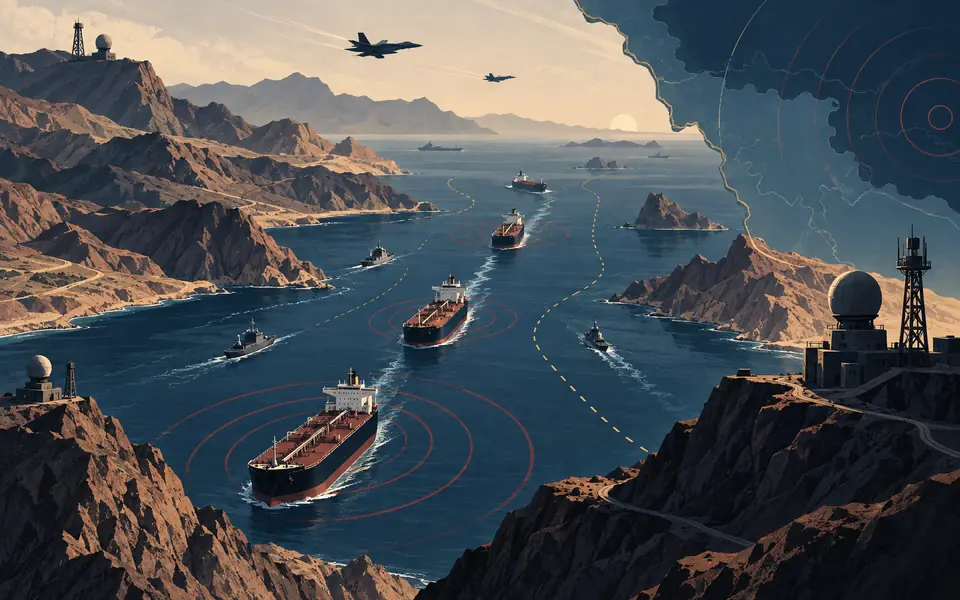
U.S. Central Command said American forces struck Islamic Revolutionary Guard Corps targets in Iran after attempted attacks on commercial shipping and U.S. personnel. Iranian officials reported civilian casualties from at least one strike; the competing accounts could not all be independently verified at publication.
President Trump confirmed the operation in a post on Truth Social, writing that the United States was striking Iranian targets near the strait as the action unfolded, and later described the strikes as large and powerful. He said they were carried out in response to Iran's attempt to plant sea mines in the strait and a missile attack on a US base in Jordan, and warned that a substantially larger response was, in his words, waiting in the wings if Iran retaliated further.
The immediate sequence of events
Tuesday's strikes came after the US and Iran exchanged fire over the weekend for the first time in roughly a month, an escalation that had appeared to catch even close observers of the conflict off guard given the relative quiet that preceded it. According to Axios, the renewed fighting began after the US struck Iranian forces that were reportedly preparing to launch sea mines into the strait, prompting Iran to respond Sunday with ballistic missile attacks on US bases in Jordan.
The immediate trigger for Tuesday's operation appears to have been a fresh attack on commercial shipping. A Reuters report cited by regional outlets described two supertankers carrying Saudi crude oil coming under attack within minutes of each other late Monday while transiting the strait, each having loaded roughly two million barrels at a Saudi export terminal the week before. No party had publicly claimed responsibility for that specific incident as of Tuesday.
How the strike plan developed
The detailed planning process has not been made public. Official statements described the operation as a response to threats against shipping and U.S. personnel, but they did not establish how long the option had been under consideration or identify every factor behind the final decision.
One US official described the underlying strategic goal in blunt terms, as reducing the risk of Iranian attacks on oil tankers and US military assets, essentially maintaining pressure on Iran's capabilities on an ongoing basis rather than through a single decisive strike. That framing lines up with a broader campaign the US military has pursued for months: gradually asserting control over most of the strait by degrading Iranian military capacity, clearing mines, and guiding commercial vessels through safely, an approach that has curtailed Iran's ability to disrupt oil tankers while eroding the country's leverage over the crucial waterway.
Iran's response and escalation risks
Iran's state-run Tasnim News Agency reported that the country's armed forces had launched what it called a decisive operation in response to Tuesday's US strikes, and said American bases and interests across the region would be targeted by Iranian missiles and drones going forward. Whether that rhetoric translates into another round of direct strikes on US positions, as happened over the weekend, remained unclear as of Tuesday evening.
The White House, asked for comment on the administration's broader posture toward Iran, said in a statement that the president retains all options at his disposal, adding pointedly that Iran, in the administration's view, wants to make a deal but continues to be a day late and a dollar short in doing so. For a conflict that has already run through multiple rounds of threatened deadlines, temporary pauses, and renewed strikes since earlier this year, Tuesday's escalation raises the stakes once again on a waterway that carries a substantial share of the world's oil supply, and on a standoff whose endpoint remains genuinely uncertain.
Sources and further reading: CENTCOM statement on the strikes · Associated Press live report
About the Author
Maria Santos
Politics Writer
Maria Santos writes about elections, courts, Congress, and public institutions. She covers legislative fights, judicial rulings, and campaign developments as they unfold. Her analysis labels projections and source attribution so readers can separate evidence from interpretation, and notes when a race or ruling is still contested.