NFL Expands Its Digital Athlete System to Inform Injury-Prevention Decisions
The NFL and Amazon Web Services use the Digital Athlete system to combine video, tracking and injury data in simulations intended to identify patterns of player risk.

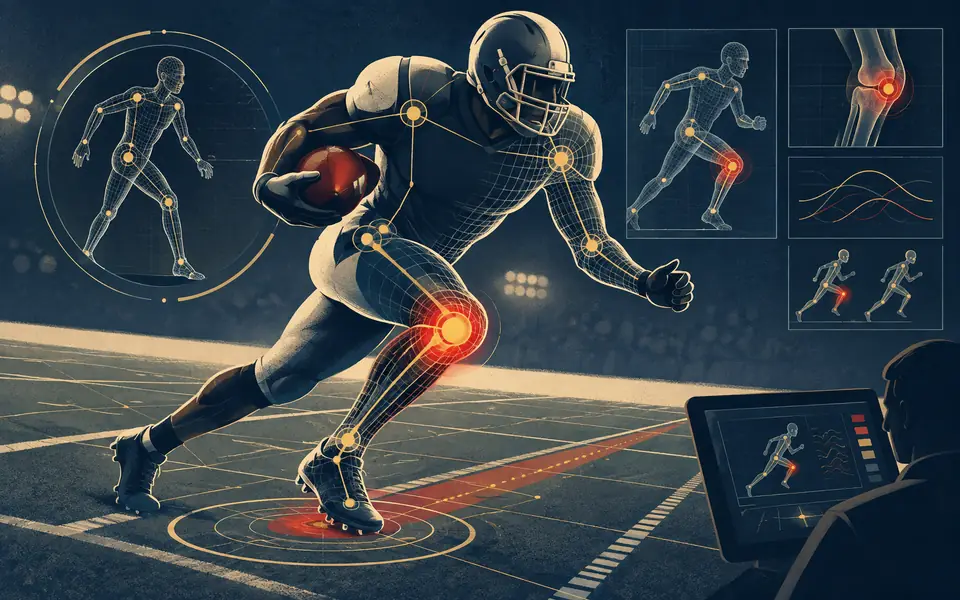
The NFL and Amazon Web Services use the Digital Athlete system to combine video, tracking and injury data in simulations intended to identify patterns of player risk. The tool can inform training, equipment and rule changes, but its forecasts are decision support rather than a guarantee that a specific injury will occur or be prevented.
The scale of the data collection behind it is hard to overstate. Every player on the field gets mapped across 29 distinct body points, tracked 60 times per second, capturing joint alignment, torque, and asymmetry in enough detail to catch subtle biomechanical changes that would be invisible to a coach watching from the sideline or even reviewing film afterward. Across the league, the system processes roughly 500 million data points every single week, drawn from 38 high-resolution stadium cameras and sensors embedded in players' shoulder pads.
From treatment to risk modeling
The fundamental shift the program represents is philosophical as much as technical. Historically, football medicine has been reactive by necessity: a player gets hurt, and the medical staff responds. Digital Athlete flips that model, using AI simulations to model how force accumulates in a player's body over the course of a game or season, essentially forecasting structural stress before it turns into torn ligaments or fractured bone. League officials describe it as running a virtual biomechanics laboratory for all 32 teams simultaneously, rather than 32 separate medical staffs each working with whatever data their own franchise happens to collect.
That predictive capability now runs on serious computing muscle. The system has simulated more than 10,000 virtual football seasons to train its models, and it's built to deliver injury-risk inferences in under 100 milliseconds, fast enough to be useful in something close to real time rather than only in post-game analysis.
How the system informs safety decisions
What makes this more than an impressive tech demo is that it's already shaping actual rule changes, and those rule changes appear to be working. Lower-extremity injuries have dropped by roughly 25% following two major interventions informed by the program's data: the 2024 Dynamic Kickoff rule redesign and the league's ban on hip-drop tackles. Both changes were built directly on patterns the Digital Athlete's models surfaced about where and how those specific injuries were actually occurring on the field, rather than relying purely on anecdotal coaching wisdom or historical injury reports.
That feedback loop, data revealing a risk pattern, the league adjusting a rule, and injury numbers actually improving afterward, is what NFL officials point to as validation that the investment is paying off in the metric that matters most to players and teams alike: games missed to injury. The league's broader Engineering Roadmap, a $60 million initiative managed through Football Research, Inc., has funded this kind of biomechanics work since 2017, when researchers first began simulating player impacts using modified crash-test dummies to understand how concussions actually happen on the field.
Use of biomechanics across sports
The NFL isn't alone in leaning this heavily on AI-driven biomechanics. San Francisco-based Infinite Athlete, formed through a 2023 merger of two established sports-tech firms, has built out its own player-tracking and biomechanics analytics platform used across multiple pro sports, reflecting how quickly this kind of technology has moved from research curiosity to standard infrastructure across American professional sports. A broader academic review published in 2025 found AI-driven biomechanics work concentrated heavily on two goals, improving athletic performance and predicting injury risk, with wearable sensors and motion-capture systems increasingly treated as standard training-room equipment rather than experimental add-ons.
For a league where player availability has become one of the most valuable and closely guarded competitive assets a team can have, that shift from reactive treatment to what officials call engineered availability management isn't just a safety story, it's increasingly a competitive one too. As the 2026 season gets underway, teams that can keep their best players healthy through data science, rather than luck or reduced practice intensity alone, are betting that translates directly into wins.
Sources and further reading: NFL overview of the Digital Athlete · AWS overview of the NFL partnership
About the Author
Daniel Osei
Sports Writer
Daniel Osei writes about major leagues, national teams, athlete performance, and the business of sport. He covers game outcomes, roster and front-office moves, and the money behind franchises, broadcasts, and sponsorships. Results and records are checked against league or governing-body data when available.