New York Marathon Draw Accepts About 1% as Major-Race Demand Grows
New York Road Runners received more than 240,000 applications for the 2026 New York City Marathon drawing and accepted about 1% of drawing applicants.

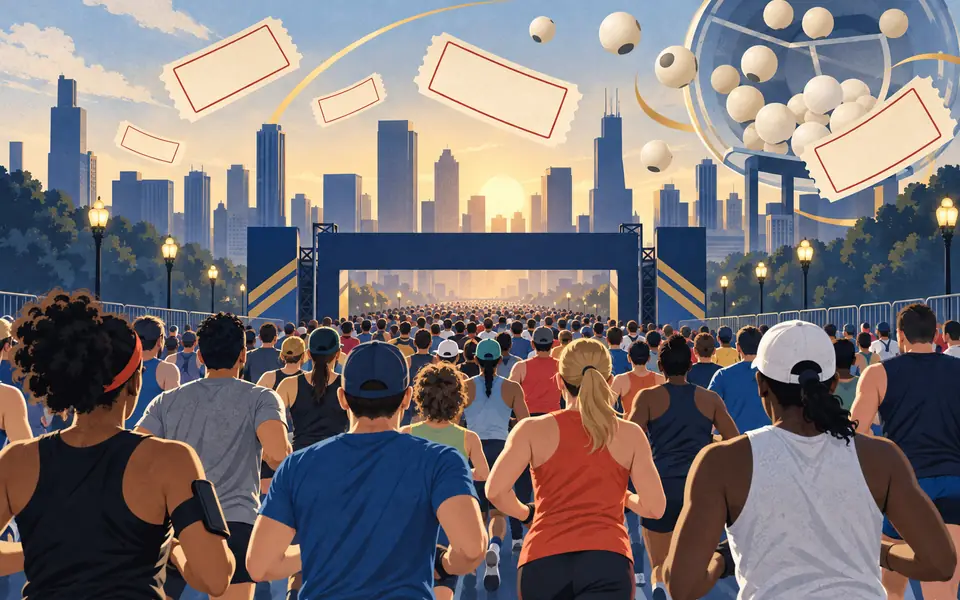
New York Road Runners received more than 240,000 applications for the 2026 New York City Marathon drawing and accepted about 1% of drawing applicants. The percentage applies to the non-guaranteed drawing, not the entire race field, which also includes qualifiers, charity runners and other guaranteed-entry categories.
Chicago tells a nearly identical story. The Bank of America Chicago Marathon drew more than 200,000 applicants competing for roughly 45,000 to 50,000 spots in its 2026 race, and organizers say demand has kept climbing even as the field size has grown to accommodate more runners. It's not a one-city phenomenon, it's the new normal across the sport's biggest American races.
Participation growth since the pandemic
The scale of this surge shows up clearly in the national participation data. According to RunSignup's RaceTrends report, overall US race participation grew 5% from 2024 to 2025, on top of 8% growth the year before that and 11% the year before that, a multi-year streak that's put to rest any lingering theory this was simply a temporary pandemic-era spike. Marathon finishers specifically jumped 14.6% in 2024 alone, and the 2025 TCS New York City Marathon set a world record as the largest marathon ever run, with 59,226 official finishers crossing the line.
Even Boston, which fills most of its field through qualifying times rather than a lottery, has felt the squeeze. For the 2026 race, the qualifying cutoff came in 4 minutes and 34 seconds faster than the previous year's standard, meaning runners who hit the official Boston Qualifying time on paper still weren't fast enough to actually get in. Race analysts describe that kind of compressing qualifying window as one more symptom of the same underlying pressure: too many runners chasing a supply of race bibs that simply can't expand as fast as demand.
Why major races cannot meet demand
Part of what makes this boom different from ordinary demand spikes is that the supply side genuinely can't stretch much further. City streets only hold so many runners at once, aid stations only cover so much ground, and most major marathons are already operating at or close to their physical capacity for a single-day event. London is exploring an expansion to a two-day race format targeting 100,000 total runners, one of the few majors actively experimenting with structural changes rather than simply tightening its lottery odds further.
That capacity ceiling has pushed race organizers, and runners themselves, toward workarounds. Charity entry programs have become one of the more reliable paths into sold-out majors: the 2025 Bank of America Chicago Marathon alone raised a record $47.1 million through charity runners, and roughly a third of this year's Chicago field is expected to be running on behalf of an official nonprofit partner, trading a hefty fundraising minimum for a guaranteed bib.
Running as a social activity
Much of this growth traces back to something bigger than the races themselves. Run clubs have exploded into genuine social hubs in cities across the country since the pandemic, turning what used to be a solitary training grind into a group activity built around community as much as competition. Strava's year-in-sport data has tracked a continued surge in new running club formation, and marathon culture more broadly has leaked well beyond its traditional endurance-sport niche, propelled by social media visibility, celebrity finishers, and a running shoe technology arms race that's made the marathon feel both faster and more achievable for everyday runners than it did a decade ago.
The performance data backs up that broader accessibility. The average American marathon finish time actually improved from 4 hours 39 minutes in 2019 to 4 hours 34 minutes in 2024, according to RunRepeat's analysis, even as the pool of participants running those times has grown dramatically wider and more varied. For runners still chasing a bib at one of the majors, race analysts increasingly offer the same practical advice: don't wait on the lottery alone, there are hundreds of other marathons across the country offering the same 26.2-mile achievement, often with a smaller field, a lower price tag, and just as memorable a finish line.
Sources and further reading: New York Road Runners drawing announcement
About the Author
Daniel Osei
Sports Writer
Daniel Osei writes about major leagues, national teams, athlete performance, and the business of sport. He covers game outcomes, roster and front-office moves, and the money behind franchises, broadcasts, and sponsorships. Results and records are checked against league or governing-body data when available.