American Cancer Society Adds New Colorectal Screening Options
The American Cancer Society's 2026 guideline continues to recommend that average-risk adults begin colorectal cancer screening at age 45 and adds blood-based and newer stool-based options.

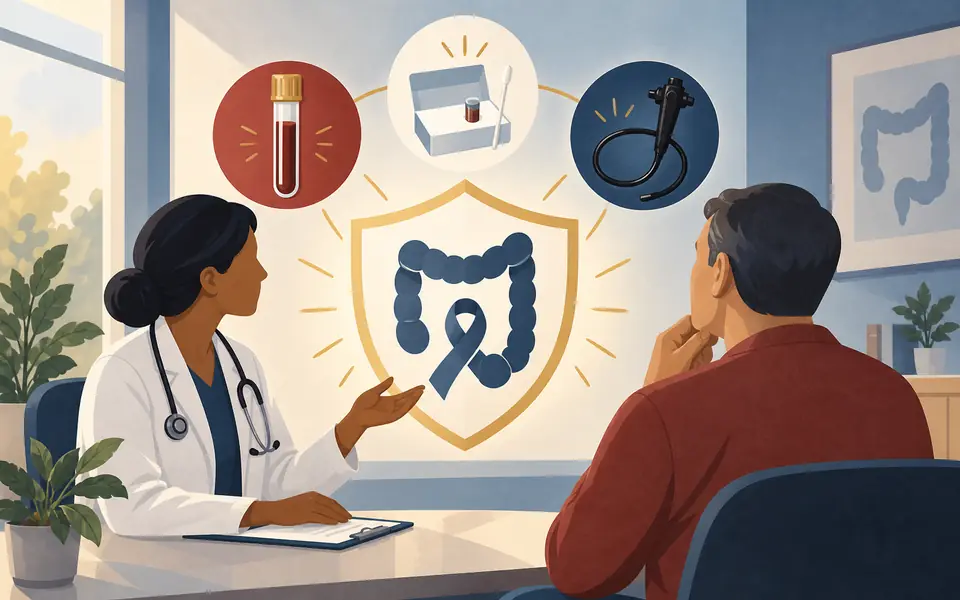
The American Cancer Society's 2026 guideline continues to recommend that average-risk adults begin colorectal cancer screening at age 45 and adds blood-based and newer stool-based options. The group says blood testing is not preferred because it misses most precancerous polyps and some cancers; an abnormal non-colonoscopy test still requires a follow-up colonoscopy.
Colonoscopy remains the gold standard in the guideline, both detecting and removing precancerous polyps in the same procedure. But the American Cancer Society has been explicit that expanding the list of alternatives isn't about replacing colonoscopy, it's about meeting the roughly 20 million eligible Americans, about one in three adults, who haven't been screened as recommended somewhere closer to where they already are.
Why screening matters
The urgency behind this update isn't abstract. Recent American Cancer Society research found that colorectal cancer has become the leading cause of cancer death among adults under age 50 in the United States, a shift that would have seemed unthinkable a generation ago, when the disease was overwhelmingly associated with older adults. Robert Smith, the organization's senior vice president for early cancer detection science and senior author of the guideline update, said broadening the available screening tools is meant to help close that gap and catch more cancers while they're still at an early, treatable stage.
The numbers on early detection make the case for screening hard to argue with: five-year survival rates top 90% when colorectal cancer is caught early, a figure that drops sharply the longer a diagnosis is delayed. That gap between what early screening can achieve and how many eligible adults actually get tested is exactly the problem the new guideline is trying to close.
New screening options
The headline addition is a blood-based test, marketed under the name Shield, which requires only a blood draw at a doctor's office and is recommended every three years for people who choose it over more invasive options. It joins two at-home stool-based tests, one updated version of an existing option and one entirely new addition, both of which work by detecting hidden blood or molecular markers that can signal the presence of polyps or early-stage cancer.
It's worth being clear-eyed about where these new options fit in the hierarchy, though. Visual exams like colonoscopy and stool-based tests remain the preferred screening methods in the guideline; the newer blood-based tests are included as a recommended option but not yet a preferred one, reflecting that they're a genuinely useful entry point for people who would otherwise skip screening entirely, even if they don't yet match colonoscopy's combined ability to both detect and immediately remove precancerous growths.
Screening options in context
Colorectal cancer isn't the only area where US screening guidance has shifted this year. Guidance for people ages 76 to 85 now explicitly frames continued colorectal screening as a personal decision, weighed against life expectancy, overall health, and prior screening history, rather than a blanket recommendation, while people over 85 are generally advised to stop screening altogether. Similar age-based, risk-adjusted frameworks now guide current US recommendations for breast, lung, cervical, and prostate cancer screening as well, part of a broader trend across American public health guidance toward more individualized rather than one-size-fits-all recommendations.
For anyone unsure where they fall in the current guidance, cancer specialists are consistent on one point: the specific test matters far less than actually getting screened. Whichever option someone is most likely to actually complete, whether that's a colonoscopy, an at-home stool kit, or a simple blood draw, is the right one for them, and talking through the options with a primary care provider remains the most reliable way to figure out which path fits an individual's risk factors and life circumstances.
Sources and further reading: American Cancer Society screening guideline · Peer-reviewed guideline update
About the Author
Sarah Kim
U.S. Health & Science Writer
Sarah Kim writes about U.S. public health, medical research, science policy, education, and federal institutions. She covers regulatory decisions, clinical research, and how federal agencies communicate risk and guidance to the public. Her posts link to primary studies and regulator guidance where available, and flag preliminary findings as such.