Army Secretary Dan Driscoll Resigns After Reported Tensions With Hegseth
Army Secretary Dan Driscoll resigned and said September 2 would be his last full day in the role.

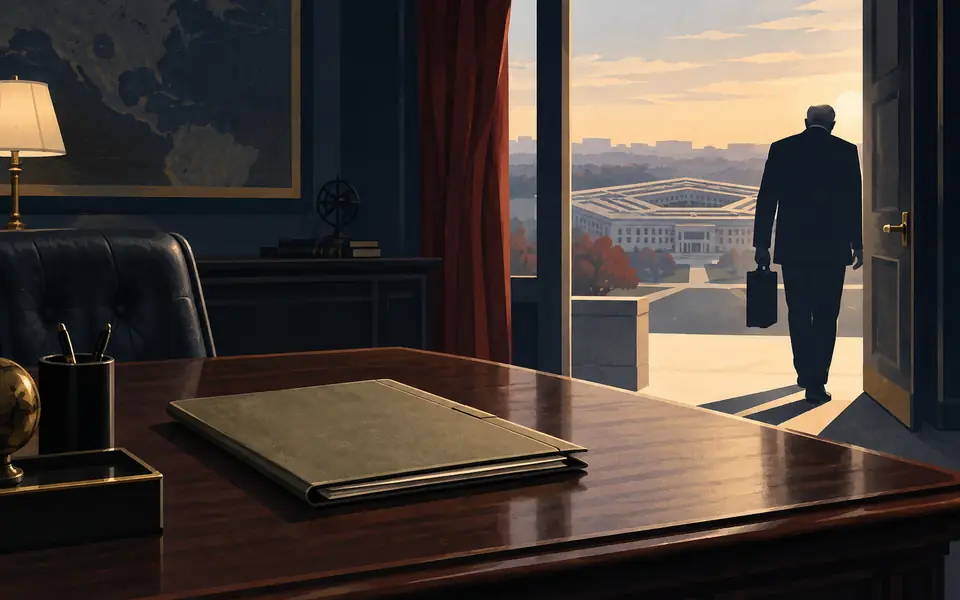
Army Secretary Dan Driscoll resigned and said September 2 would be his last full day in the role. Driscoll did not give a public reason for leaving; reports have described disagreements with Defense Secretary Pete Hegseth, so the cause should be treated as attributed reporting rather than an established official explanation.
One source told reporters the decision wasn't a surprise given the friction between Driscoll and Defense Secretary Pete Hegseth. A second source said Driscoll's resignation letter raised concerns about the administration's approach to Army transformation and military readiness, and specifically pointed to Hegseth's role in blocking those efforts by removing the generals responsible for carrying them out.
Reported tensions over personnel decisions
The rupture between the two men traces back at least in part to earlier this year, when Hegseth fired Army Chief of Staff General Randy George along with two other senior generals. Driscoll had worked closely with George, and in April congressional testimony, he spoke warmly of the general's four decades of service and Purple Heart, calling him an amazing, transformational leader. Lawmakers from both parties pressed Hegseth on the firings at the time and voiced their own admiration for George, a sign the tension wasn't confined to internal Pentagon politics.
Public reporting indicated that the disagreement deepened in the weeks before Driscoll's resignation. The available official statements did not provide a detailed account of the dispute, so claims about the private decision-making process should be treated as attributed reporting rather than established fact.
Driscoll's background
Driscoll, an Army veteran who served one deployment in Iraq and holds a Ranger tab, came to the role from a background in venture capital and Republican politics rather than a traditional military career track. He ran an unsuccessful 2020 campaign for North Carolina's 11th Congressional District before working as an advisor on Trump's 2024 reelection campaign, and is a close, longtime friend of Vice President JD Vance. He took over as Army secretary in February 2025 and simultaneously served as acting director of the Bureau of Alcohol, Tobacco, Firearms and Explosives until April of this year.
During his time in the role, Driscoll pushed hard on modernization and acquisition reform, and the White House credited him with helping negotiate elements of the Russia-Ukraine talks alongside his Pentagon duties. In a statement following the resignation, White House spokeswoman Anna Kelly said Driscoll had been highly effective in advancing the administration's national security agenda and had provided outstanding leadership during a stretch of historic military operations.
What happens next
It's not yet clear who will step into the role. Under normal succession, the Army's undersecretary, a position currently held by Michael Obadal, would typically take over, and an Army official has described Obadal as having a strong working relationship with Hegseth. But Hegseth retains the authority to name whoever he wants to serve in an acting capacity, with no obligation to elevate Obadal either temporarily or as a permanent nominee.
One name already circulating as a possible successor is Sean Parnell, an Army veteran and political operative currently serving as the Pentagon's chief spokesman, who reporting earlier this year indicated had expressed interest in the job following the abrupt removal of General George. Driscoll's exit adds to a pattern that's defined Hegseth's tenure at the Pentagon since he took office in January 2025, one marked by a string of firings and early departures among senior military and civilian leadership.
Sources and further reading: Associated Press report on Driscoll's departure
About the Author
Sarah Kim
U.S. Health & Science Writer
Sarah Kim writes about U.S. public health, medical research, science policy, education, and federal institutions. She covers regulatory decisions, clinical research, and how federal agencies communicate risk and guidance to the public. Her posts link to primary studies and regulator guidance where available, and flag preliminary findings as such.