Researchers Use AI to Read an Entire Herculaneum Scroll Without Opening It
Researchers working with the Vesuvius Challenge virtually unwrapped and read PHerc. 1667, the first Herculaneum scroll recovered end to end without being physically opened.

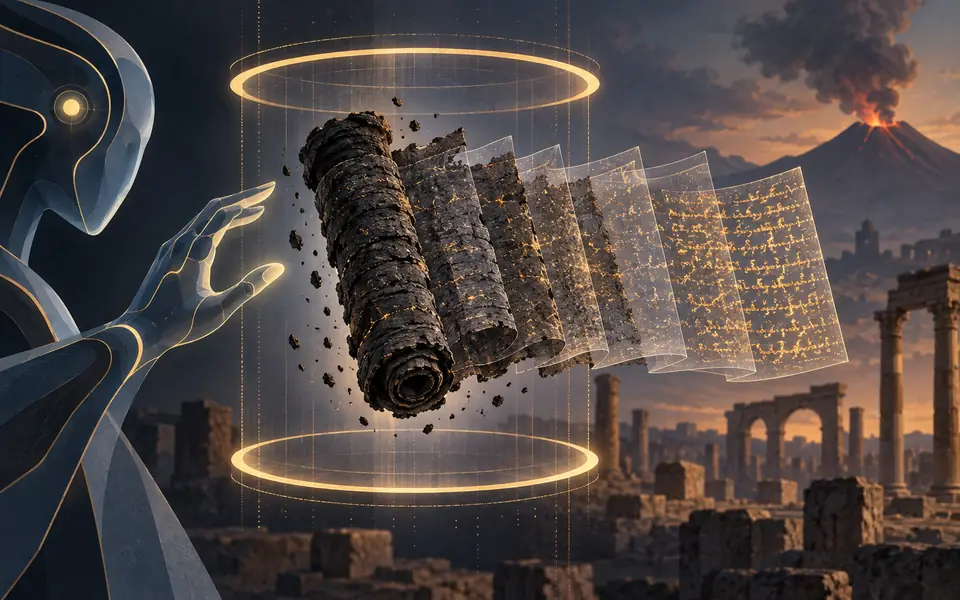
Researchers working with the Vesuvius Challenge virtually unwrapped and read PHerc. 1667, the first Herculaneum scroll recovered end to end without being physically opened. The method combines high-resolution X-ray scans, computational surface reconstruction and machine-learning models that detect ink in the carbonized papyrus.
The breakthrough is the latest milestone from the Vesuvius Challenge, a competition founded by US technology executives that has now paid out $1.8 million in prize money to researchers and computer scientists racing to crack open these ancient documents virtually. The approach combines high-resolution CT scanning with machine learning models trained to detect the faint traces of carbon-based ink on carbonized papyrus, then digitally unrolls the scroll's internal layers into a flat, readable surface.
How virtual unwrapping works
The technical challenge here is genuinely strange, even by archaeology standards. The scrolls are scanned inside a particle accelerator to produce extraordinarily detailed 3D X-ray images, since standard imaging can't distinguish carbon-based ink from the carbonized papyrus it sits on, the two are nearly identical in density. Machine learning models trained on thousands of scanned fragments learn to pick out the subtle textural differences that mark where ink was applied, effectively teaching a computer to see something the human eye simply cannot.
Nat Friedman, the US tech executive who helped found and fund the Vesuvius Challenge, described this latest full-scroll result as only the beginning, and said researchers expect meaningful further improvements in both the AI algorithms and the ink-detection methods that made the breakthrough possible. He's also been actively recruiting more computing talent to join the effort, betting that the hardest technical problems left in the project are exactly the kind that a wider pool of researchers might crack faster.
Other uses of AI in historical research
The Herculaneum breakthrough isn't happening in isolation. Across American universities, classics and digital humanities departments have quietly become some of the more surprising adopters of cutting-edge AI over the past couple of years. At the University of Iowa, classics professor Paul Dilley recently secured a $500,000 grant from the philanthropic research funder Schmidt Sciences to train AI models capable of suggesting plausible reconstructions for missing or damaged sections of ancient manuscripts, a project he expects to run for the next three years.
Dilley has been careful to frame the technology as a research aid rather than a replacement for traditional scholarship, emphasizing that human experts still need to have the final word on what a damaged passage most likely said. Similar caution runs through much of the field. Researchers at the University of Notre Dame have spent recent years developing neural networks capable of transcribing complex medieval handwriting, and have already adapted the system to read Ethiopian manuscripts written in an entirely different character set, a first step toward tools that could eventually handle multiple ancient languages at once.
Limits of the method
Not every part of this pipeline is going smoothly. A recent benchmarking study testing large language models against the full workflow of preparing a scholarly digital edition found that while top AI systems scored above 90 out of 100 on straightforward ancient-language translation and grammar parsing, their performance dropped sharply, down to 60 to 74 out of 100, when asked to generate the structured technical metadata scholars actually need to catalog a manuscript properly. The models frequently invented catalog formats that don't exist or misapplied technical markup, a reminder that reading ancient text and correctly documenting it for other researchers remain two very different problems.
Rutgers digital humanities librarian Francesca Giannetti, who has watched the field evolve closely, says classicists arrived at a similar realization early on: computational tools would clearly help with the grinding, technical work of the discipline, but they were never going to substitute for the trained judgment scholars bring to interpreting what a damaged or ambiguous passage actually means. The Herculaneum scroll result suggests just how far the technical side of that partnership has already come, even as the harder questions of meaning and context remain firmly in human hands.
Sources and further reading: Vesuvius Challenge project summary · Research preprint on PHerc. 1667
About the Author
Raj Patel
World & Technology Writer
Raj Patel writes about international affairs, science, technology, and cross-border industry. He covers diplomatic developments, emerging technology, and the global supply chains linking distant economies. His posts identify official claims and distinguish them from independently established facts, with attention to how a story is being reported differently across regions.