Nepal-China Border Floods Leave Hundreds Dead and Thousands Missing
A rock-and-ice collapse high in the Himalayas on August 26 triggered a destructive flood along river valleys near the Nepal-China border.

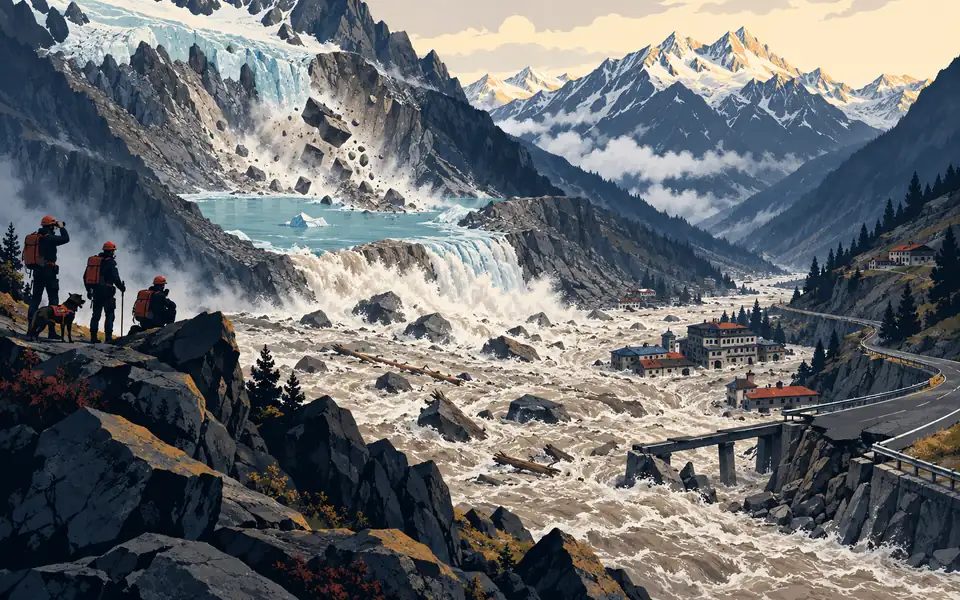
A rock-and-ice collapse high in the Himalayas on August 26 triggered a destructive flood along river valleys near the Nepal-China border. The disaster struck settlements and the Gyirong border crossing with little warning; casualty and missing-person figures were still changing when this article was last updated.
Five days later, the scale of the disaster is still coming into focus, and the numbers keep climbing. Nepali authorities have confirmed at least 903 deaths with 4,247 people still missing, while Chinese officials in the Tibet Autonomous Region have reported 16 dead and 546 missing on their side of the border. The flood struck settlements along a roughly 45-mile stretch of the Trishuli River, and floodwaters carried the bodies of some victims as far as 150 miles downstream into neighboring India.
The search-and-rescue effort
Rescue crews have been working around the clock since the disaster struck, but they're contending with obstacles that would slow down any recovery effort: wrecked roads and bridges, widespread power outages, and mountainous terrain that's difficult to reach even in ordinary conditions. Search teams are acutely aware of the window they're working against — the first 48 to 72 hours after a disaster like this are typically regarded as the best chance of finding survivors, and that window has now closed for most of the missing.
The disaster hasn't stayed contained to Nepal and China. Foreign nationals from more than a dozen countries are among the missing, including dozens of Americans who had been traveling with a tour group of roughly 50 people at the time floodwaters struck. South Korean officials said nine of their citizens working on a hydropower project in the area are unaccounted for, and Malaysia's foreign ministry said 11 of its nationals lost contact while believed to be in the Rasuwa district. Family members reached by journalists in the days since have described a mix of desperate hope and mounting grief as they wait for any word.
Risks remain after the flood
Adding to the anguish of the search effort, the immediate physical danger in the region hasn't fully cleared. A barrier lake formed by the initial landslide has begun overflowing near the flood zone, and while Chinese officials described the situation as stable on Sunday and said a complete breach appeared unlikely, Nepali disaster authorities issued fresh alerts over the weekend warning residents near the Bhote Koshi River to stay alert as water flow increased. A second glacial lake elsewhere in the mountains has also been swelling, and meteorologists have warned that more rain could complicate both the search effort and the risk of further flooding.
What investigators still need to establish
Scientists are still piecing together exactly what caused the glacier collapse, though early analysis points to a familiar and increasingly urgent culprit: a warming Himalaya. Disaster risk researchers note the region experienced a similar flash flood just fourteen months ago, when a glacial lake overflow in Tibet caused significant damage, and a comparable event struck the same border area in August of last year as well. Climate scientists have repeatedly flagged glacial lake outburst floods as a growing hazard across the Himalayas as rising temperatures destabilize ice formations that have remained largely static for generations.
The disaster has also drawn attention to how differently the two affected countries are handling information in its aftermath. International reporters have noted that footage and details from the Tibetan side of the border have been considerably harder to verify than reporting from Nepal, with some video from the affected region reportedly appearing briefly online before being taken down. Nepal's government, for its part, has formally requested search-and-rescue assistance from both India and China as it works to reach the more than 4,000 people still unaccounted for on its side of the border.
For now, families on multiple continents are left in the same painful position: waiting for news that may not come, and holding on to whatever hope the search effort can still offer. As one relative of two missing American tourists put it in the days after the flood, there's no room left for being afraid — only for hoping.
Sources and further reading: Kathmandu Post casualty update · Associated Press report on information gaps
About the Author
Raj Patel
World & Technology Writer
Raj Patel writes about international affairs, science, technology, and cross-border industry. He covers diplomatic developments, emerging technology, and the global supply chains linking distant economies. His posts identify official claims and distinguish them from independently established facts, with attention to how a story is being reported differently across regions.