U.S. Clean-Energy Investment Rises 22% to $75 Billion in the Second Quarter
U.S. investment in clean energy and transportation totaled $75 billion in the second quarter of 2026, a 22% increase from the previous quarter.

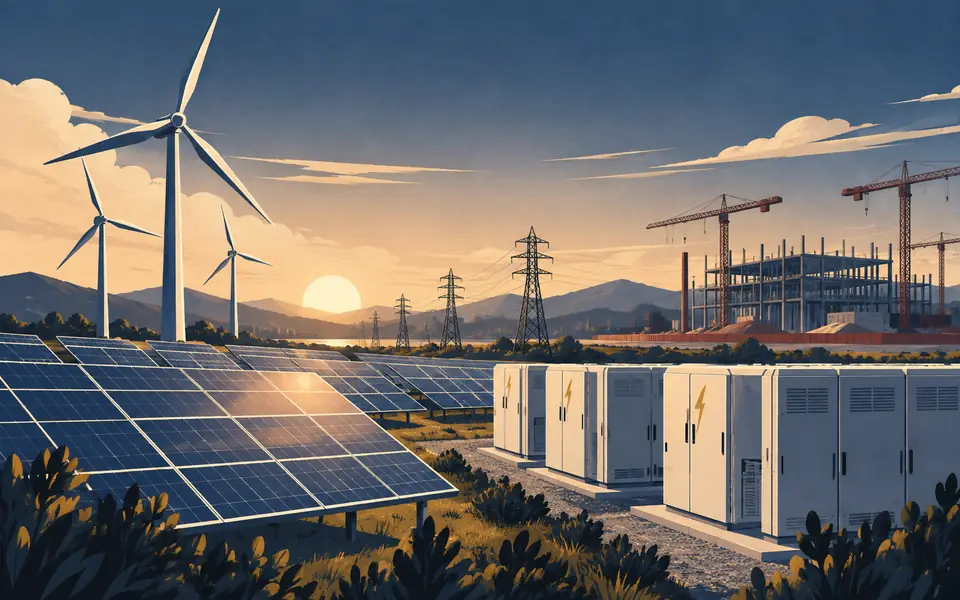
U.S. investment in clean energy and transportation totaled $75 billion in the second quarter of 2026, a 22% increase from the previous quarter and the second-highest quarterly total in the Clean Investment Monitor's series. Deployment spending grew, especially for distributed generation and storage, while cancellations continued to weigh on domestic manufacturing projects.
Both numbers are real, and reconciling them requires looking at where the money is actually going. The surge isn't being driven by new factories breaking ground — it's coming almost entirely from deployment: batteries, solar panels, and storage systems that are already cheap enough and proven enough that homeowners and grid operators are buying them regardless of what's happening in Washington on the incentive front.
Battery-storage investment
The single biggest driver of the quarter's jump was distributed electricity generation and storage, which reached nearly $12 billion in investment, more than double the roughly $5 billion recorded just one quarter earlier and the highest total on record for that category. Residential battery storage installations actually surpassed residential solar installations for a second straight quarter, now accounting for about 75% of all investment in that segment — a sign that homeowners increasingly see a battery, not just panels on the roof, as the real prize.
Utility-scale battery deployment is having its own breakout year. The US is on pace to install roughly 24,000 megawatts of utility-scale battery capacity in 2026, a 60% jump over last year, as developers increasingly pair batteries directly with solar farms to store cheap midday power and sell it back to the grid during expensive evening peak hours. Grid operators already have plans to add another 54 gigawatts of battery capacity by the end of 2028, which would roughly double the nation's total storage capacity again by 2030.
A weaker picture for manufacturing
The factory side of the industry tells a much rougher story. Companies announced about $7.9 billion in new clean energy manufacturing investments in the second quarter while simultaneously canceling $2.9 billion in previously announced projects, most of that concentrated in electric vehicle assembly, solar, and hydrogen electrolyzer manufacturing. Two of the largest planned electrolyzer plants in the country were either canceled outright or put on hold during the quarter.
Perhaps the starkest illustration of how much the investment climate has cooled: from mid-2023 through the end of 2024, companies announced 24 clean energy manufacturing projects worth more than $1 billion each. In the eighteen months since, there have been just three. The largest of those three, Convalt Energy's planned $5 billion solar manufacturing campus in New Mexico, now stands out as something of an outlier rather than a sign the investment floodgates have reopened.
Why deployment and manufacturing diverge
The split traces back largely to policy. The elimination of federal tax incentives under the One Big Beautiful Bill Act has made it harder to justify building new domestic factories, even as the same shift, combined with a long stretch of falling solar and battery equipment prices, has made it easier and cheaper than ever to actually deploy the technology once it's built somewhere. Manufacturing investment did tick up 4% quarter-over-quarter, breaking a six-quarter streak of consecutive declines, but analysts caution that one quarter of modest improvement doesn't undo eighteen months of retreat.
Solar manufacturing in particular remains caught in a bind: even after the US worked to bring its entire supply chain onshore over the past few years, domestic manufacturers still struggle to access the components and basic infrastructure materials, like steel, needed to actually build panels at scale, given current trade policy. Industry analysts describe global manufacturing capacity as facing severe, persistent oversupply that's outpacing even the healthy demand growth projected for 2026.
Implications for investors and policymakers
For anyone trying to gauge where US clean energy is really headed, the lesson from this quarter is that the sector isn't collapsing, but it is bifurcating. Deployment-side businesses — the companies installing batteries, panels, and storage systems that are already commercially proven — are thriving on falling costs and strong underlying demand. Manufacturing-side businesses betting on new US factories are navigating a far chillier environment, one where policy uncertainty and thin incentive support are doing more to determine which projects survive than raw technology economics alone.
Sources and further reading: Clean Investment Monitor Q2 2026 update
About the Author
Elena Vasquez
Finance Writer
Elena Vasquez writes about markets, interest rates, household finance, and economic data. She tracks Federal Reserve policy, inflation reports, and how monetary decisions filter down to borrowing costs and household budgets. Her posts separate observed figures from forecasts and interpretation, citing primary data releases wherever they're available.