Supreme Court Allows White House Ballroom Construction to Continue During Appeal
The Supreme Court allowed construction of President Donald Trump's planned White House ballroom to continue while litigation proceeds.

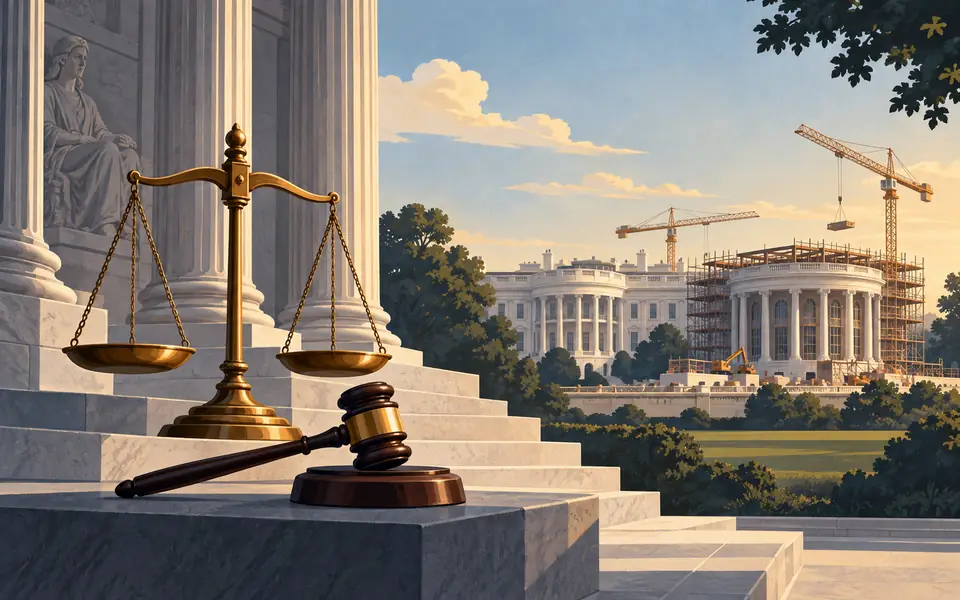
The Supreme Court allowed construction of President Donald Trump's planned White House ballroom to continue while litigation proceeds. The apparent 5-4 decision turned on whether the preservation group challenging the project was likely to have standing, and did not finally resolve whether the construction itself is lawful.
The ruling followed an interim decision along similar lines issued on August 21 by Chief Justice John Roberts, who allowed the emergency stay to take effect while the full court weighed a final answer. That final answer, delivered ten days later, kept construction moving but stopped well short of declaring the project legal.
An interim order, not a decision on the merits
What makes this ruling notable isn't really the outcome, it's the reasoning behind it. The court's majority didn't rule that Trump had the authority to demolish the East Wing and build a 90,000-square-foot ballroom in its place; instead, the justices found that the National Trust for Historic Preservation, the nonprofit that brought the legal challenge, likely lacks standing to sue in the first place. Brent Leggs, the Trust's president and CEO, said in a statement that the organization was deeply disappointed in the ruling but noted pointedly that the majority never actually weighed in on whether the ballroom project itself was lawful.
That distinction mattered enough to split the court in an unusual way. Chief Justice Roberts, typically aligned with the court's conservative wing, joined the three liberal justices, Sonia Sotomayor, Elena Kagan, and Ketanji Brown Jackson, in dissent. Roberts, writing for the dissenting group, argued the majority had drawn the rules governing who can sue in federal court too narrowly, effectively allowing what four justices believe is likely an unconstitutional overreach of presidential authority to continue simply because of who was allowed to challenge it in court.
How the case reached the Supreme Court
The legal fight traces back to March, when US District Judge Richard Leon, a George W. Bush appointee, ruled in the Trust's favor and ordered construction halted, writing bluntly that no statute comes close to giving the president the authority he claims to have over the property. Leon later clarified that below-ground construction, including work on a Cold War-era bunker beneath the East Wing, could continue, but the ballroom structure itself could not proceed without congressional approval. The DC Circuit Court of Appeals subsequently ruled 2-1 against the administration before the case reached the Supreme Court on an emergency basis.
Trump has been unambiguous about his personal investment in the project throughout the legal back-and-forth, telling reporters aboard Air Force One in March that the judge who first blocked construction was simply wrong, and insisting Congress had no role to play because the roughly $400 million project is privately funded rather than paid for with taxpayer money. He has increasingly referred to it as the Military/Ballroom Complex, framing the addition, which will roughly double the size of the existing White House complex, as serving national security purposes alongside its function as an event space.
Remaining legal questions
As of court filings from mid-August, the administration reported the project was roughly 65% complete, with a 250-person construction crew working around the clock, seven days a week. That pace of construction is exactly what worried the dissenting justices: because the challenged conduct is the physical building itself, every week the project continues changes the practical reality on the ground, regardless of how the underlying legal question about presidential authority eventually gets resolved.
Public opinion on the project has leaned skeptical since it began. An April poll from The Washington Post, ABC News, and Ipsos found 56% of Americans disapproved of Trump's decision to tear down the East Wing to make way for the ballroom. Legally, though, Monday's ruling is explicitly not the last word. As the Trust's Leggs put it in his statement, the case still hasn't resolved the underlying argument at the heart of the dispute: whether any single president, as what he called a temporary steward of the People's House, has the unilateral authority to demolish and redesign it without Congress ever weighing in.
Sources and further reading: Associated Press report on the Supreme Court order · Supreme Court application docket filing
About the Author
Maria Santos
Politics Writer
Maria Santos writes about elections, courts, Congress, and public institutions. She covers legislative fights, judicial rulings, and campaign developments as they unfold. Her analysis labels projections and source attribution so readers can separate evidence from interpretation, and notes when a race or ruling is still contested.