Dick's Sporting Goods Shares Fall 31% After Foot Locker Weakness Prompts Outlook Cut
Shares of Dick's Sporting Goods fell 30.7% after the retailer missed second-quarter profit expectations and reduced its full-year outlook.

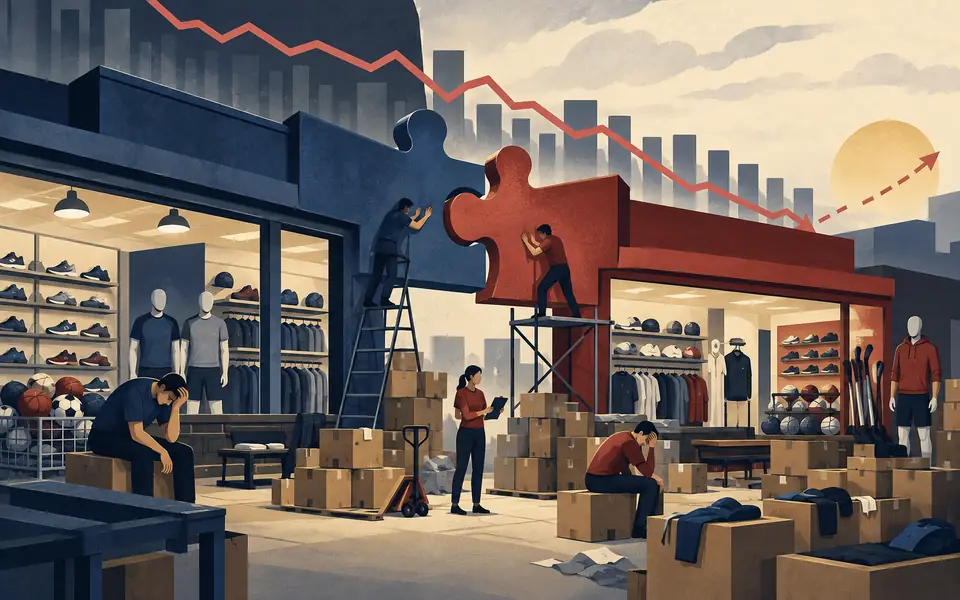
Shares of Dick's Sporting Goods fell 30.7% after the retailer missed second-quarter profit expectations and reduced its full-year outlook. The company said weaker results at Foot Locker, which it acquired in 2025, outweighed comparable-sales growth in its core Dick's business.
On paper, the quarter wasn't a total disaster. Dick's own legacy stores, the business the company built its name on, grew comparable sales by 4.9%, helped along by a surge of World Cup-related merchandise and shoppers spending more per visit. That's a genuinely strong number in a retail environment where plenty of chains would be thrilled to post growth at all right now.
How Foot Locker affected the results
So what spooked investors? One word, mostly: Foot Locker. Dick's closed its $2.4 billion acquisition of the sneaker chain back in 2025, betting the deal would expand its footprint internationally and sharpen its edge in athletic footwear. Instead, Foot Locker turned into the drag on an otherwise solid quarter, with comparable sales there falling 3.6% and the segment posting an operating loss of roughly $32 million.
Combined companywide revenue came in at $5.59 billion, up more than 53% year over year thanks to Foot Locker now being folded into the results, but that was still shy of the roughly $5.64 billion analysts had penciled in. Adjusted earnings landed at $3.53 a share, down from $4.38 the year before and below consensus estimates near $3.76. Net income slipped to $315 million from $381 million a year earlier.
The revised full-year forecast
What really sent the stock into freefall wasn't the quarter itself so much as what management said about the rest of the year. Dick's slashed its full-year earnings guidance to a range of $10.94 to $11.94 per share, a steep cut from its earlier forecast of $13.27 to $14.27. Executives also lowered the sales outlook specifically for Foot Locker, essentially admitting the turnaround they'd promised investors is taking longer, and proving harder, than expected.
Management pointed to a brutally promotional athletic footwear and apparel market as the root cause — heavy discounting across the industry, a lighter slate of buzzy sneaker launches than usual, and softer demand for older, legacy shoe styles that used to sell themselves. Dick's said it's now leaning into that price war itself to protect market share, which tends to be good news for shoppers and bad news for margins.
Pressure across the industry
The pain wasn't contained to one stock. Dick's warning rattled other sportswear and footwear names too, feeding into a broader narrative that the athletic apparel category is going through something of a hangover between big product cycles, waiting on the next wave of must-have sneakers or apparel innovation to reignite consumer excitement. For an industry that's leaned heavily on hype-driven launches in recent years, a quiet stretch on the innovation front apparently hits harder than most people expected.
How to assess the sell-off
Not everyone on Wall Street is convinced the market's reaction was proportionate. CNBC's Jim Cramer argued investors shouldn't give up on Dick's, pointing out that the company's core business — the stores that made it a household name long before Foot Locker entered the picture — is still growing at a healthy clip. He framed Foot Locker as a tougher fix than management anticipated, but not evidence the whole company is unraveling.
There were some quieter signs of confidence, too. At least one company director bought a sizable chunk of shares shortly after the crash, a move some investors read as a vote that the stock's drop had gone further than the underlying business justified. After the plunge, Dick's now trades at a forward price-to-earnings ratio well below the broader S&P 500 average, which value-focused investors will likely be watching closely in the weeks ahead.
Sources and further reading: Reuters report on Dick's results
About the Author
James Carter
Business Writer
James Carter writes about companies, trade policy, manufacturing, and corporate strategy. He covers earnings, executive decisions, supply chains, and the deals reshaping major industries. His posts link to the public records and source material used for their central claims, and separate company guidance from independently verified figures.