Fed Chair Warsh Says Rate Increases Remain Possible if Inflation Persists
Federal Reserve Chair Kevin Warsh said at the Jackson Hole Economic Symposium that inflation remains too high and that additional interest-rate increases could be needed.
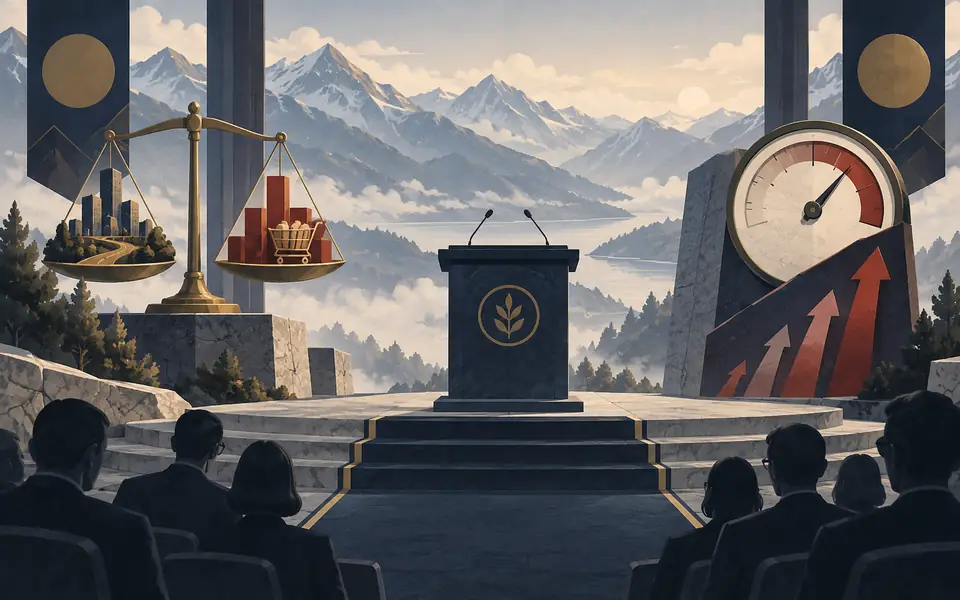
Federal Reserve Chair Kevin Warsh said at the Jackson Hole Economic Symposium that inflation remains too high and that additional interest-rate increases could be needed. He did not commit to a move at the Fed's September meeting, leaving the decision dependent on incoming inflation and labor-market data.
It was a notable departure from how the job usually gets done. For more than twenty years, whoever sits in the Fed chair has used the Jackson Hole keynote to more or less telegraph where interest rates are headed, giving markets a clear signal to trade on. Warsh skipped that part entirely, and by most accounts, that omission was very much intentional.
Inflation remains above target
The numbers behind his caution aren't subtle. Consumer prices climbed 3.4% over the twelve months through July, while the Fed's preferred inflation gauge came in even higher, at 3.7% — both comfortably above the central bank's long-standing 2% target. Warsh didn't pretend those figures were something other than what they are, telling the room bluntly that recent readings, while better than feared, don't convince him that the deeper inflation trend has genuinely turned a corner.
He recommitted to the Fed's 2% target as the institution's central priority and made clear that taming price growth, not chasing new tools or theories, remains job number one. That framing put him more clearly at odds with pressure from the White House to push interest rates lower, and it raised the stakes considerably for the Fed's next policy meeting in mid-September.
How Warsh's position has changed
Part of what made Friday's remarks notable is how much they diverged from the version of Warsh that campaigned for the job in 2025. Back then, he'd floated the idea that rapid advances in artificial intelligence might justify lower interest rates, and he'd argued that shrinking the Fed's balance sheet could be reason enough to cut as well — both positions that lined up neatly with calls from the White House for cheaper borrowing costs.
On Friday, he walked much of that framing back, telling attendees that questions about AI and the balance sheet aren't driving near-term policy decisions and that short-term interest rates remain the Fed's primary lever. He also used part of the speech to address criticism of his uneven performance at press conferences since taking the job, insisting he can be judged on results rather than on how polished he sounds in the moment.
Economic strengths and warning signs
Warsh wasn't entirely gloomy about the broader economy. He pointed to healthy business investment and noted that profits across S&P 500 companies have grown roughly 20% over the past year, evidence he cited as proof the economy has genuine underlying strength. He also described the labor market as being at full employment, chalking up a recent slowdown in hiring to a flattening supply of available workers rather than any deeper weakness.
Even so, he was careful not to let that optimism bleed into any promise about future policy. Rather than offering forward guidance or spelling out exactly what data would trigger a rate move, Warsh argued that leaning too heavily on Fed signals trains markets to look to the central bank for their next trade instead of doing their own independent analysis — a dynamic he suggested has done more harm than good in the past, pointing to the Fed's forward guidance during 2021 as an example of when clear signaling arguably slowed the response to rising inflation.
What to watch at the September meeting
Investors didn't need an explicit signal to draw conclusions. Bond traders and market strategists broadly read the tone of the speech as hawkish, with many now pricing in a real chance the Fed could raise rates rather than cut them at the September meeting, a reversal from what many had expected earlier in the summer. With inflation still running well above target and Warsh unwilling to rule anything out, markets are left doing what he seemed to want all along: forming their own view, rather than waiting for the Fed to hand them one.
Sources and further reading: Associated Press report on Warsh's speech
About the Author
James Carter
Business Writer
James Carter writes about companies, trade policy, manufacturing, and corporate strategy. He covers earnings, executive decisions, supply chains, and the deals reshaping major industries. His posts link to the public records and source material used for their central claims, and separate company guidance from independently verified figures.