U.S. Hospitals Expand AI Use as Physician Workloads Increase
Hospitals are adopting AI for documentation, scheduling, imaging and other clinical or administrative tasks as physicians report high workloads.

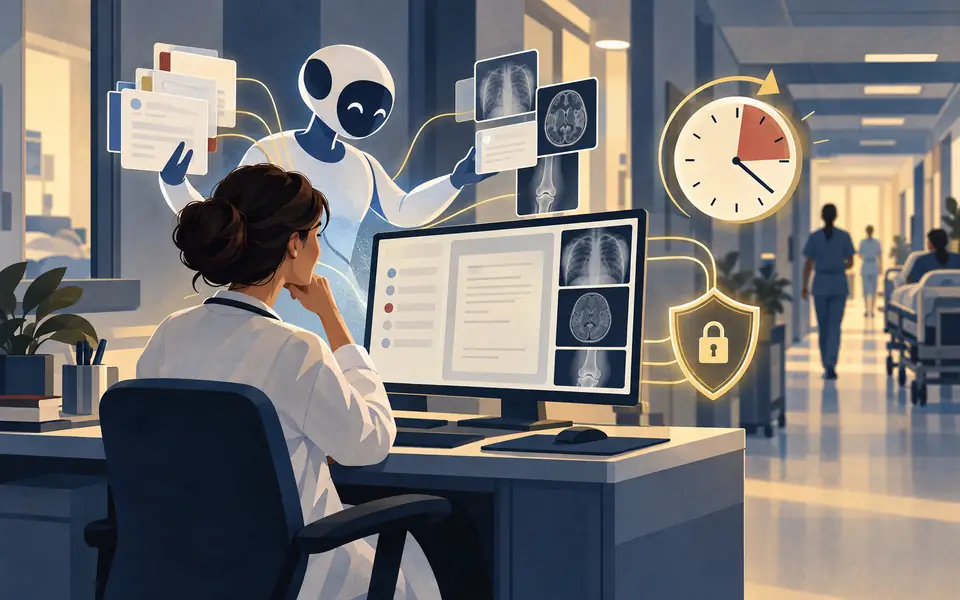
Hospitals are adopting AI for documentation, scheduling, imaging and other clinical or administrative tasks as physicians report high workloads. Evidence is strongest for time savings in narrowly defined workflows; claims that AI can solve staffing shortages or improve diagnoses at scale still require independent evaluation.
The pressure driving that adoption is demographic as much as technological. More than 10,000 Americans turn 65 and age into Medicare every single day, even as a wave of practicing physicians nears retirement themselves. The Association of American Medical Colleges projects the country could face a shortage of up to 86,000 physicians by 2036, an improvement from earlier, grimmer forecasts of 124,000, but still a substantial gap in a system where hospitals are already operating on razor-thin margins of roughly 1.5%.
Where hospitals are using AI
The clearest, most measurable wins so far aren't in diagnosis, they're in paperwork. AI scribes and ambient listening tools, which automatically transcribe and summarize patient visits, are associated with a 40% to 45% reduction in physician documentation time, according to industry surveys. That matters more than it might sound: physicians have historically spent less than a third of their working hours actually with patients, with the rest swallowed by charting, notes, and administrative overhead that AI tools are increasingly absorbing instead.
A 2026 survey from Doximity found that adoption is already broadest among younger physicians, with more than 61% of doctors under 30 reporting they currently use AI in their practice, compared with 55% among physicians in their 50s. Neurology, gastroenterology, and internal medicine reported the highest current usage rates among medical specialties. Notably, even among physicians 60 and older, where adoption is lower, only 11% said they had no interest in using AI tools at all, suggesting resistance to the technology is fading even among more veteran doctors.
How physicians might use saved time
The same survey asked doctors what they'd actually do with hours reclaimed from administrative work, and the answers cut against any narrative that physicians are simply looking to work less. Nearly 37% said they'd want to spend more time with their existing patients, while almost one in five said they'd use the freed-up capacity to take on new patients entirely, a detail that matters given how directly patient access ties back to the physician shortage discussion in the first place.
Limits of the workforce argument
Not every physician is convinced AI is solving the problem most people think it's solving. Dr. Marc Ayoub, a practicing physician, has argued publicly that framing this as a doctor shortage at all is a mistake, describing it instead as a distribution problem: the physicians largely exist, he argues, but the system is remarkably effective at preventing qualified doctors from practicing where patients actually need them, whether that's rural communities, specific specialties, or underserved regions. Under that view, pouring AI into hospitals that are already well-staffed does little to fix the deeper structural mismatch between where doctors are and where patients live.
That critique doesn't dismiss AI's usefulness so much as complicate the story around it. Even AI's more enthusiastic backers in the field tend to agree it won't fix reimbursement policy or single-handedly erase workforce gaps with a software update; the more grounded claim is that it can give physicians back meaningful hours in their day and reduce the burnout that's been pushing experienced doctors toward early retirement or reduced hours in the first place.
Why diagnostic uses require more evidence
It's worth being precise about where AI's clinical strengths actually sit right now. Narrow AI models, tools built for a single, well-defined task like flagging a particular pattern on a radiology scan, can already reach genuinely high, specialist-level performance. Radiology is where the vast majority of FDA-cleared AI medical devices are concentrated for exactly that reason. But more general-purpose AI systems, the kind that would need to weigh a complex, ambiguous case the way a physician does, still lag meaningfully behind human specialists on open-ended diagnostic reasoning.
That gap helps explain why most hospital AI deployments today are framed around triage, documentation, and flagging cases for physician review, rather than autonomous diagnosis. The technology's near-term role looks less like replacing physicians and more like clearing enough of the noise around them that the doctors who do exist can spend more of their limited time on the patients who need them most.
Sources and further reading: Doximity 2026 AI report
About the Author
Sarah Kim
U.S. Health & Science Writer
Sarah Kim writes about U.S. public health, medical research, science policy, education, and federal institutions. She covers regulatory decisions, clinical research, and how federal agencies communicate risk and guidance to the public. Her posts link to primary studies and regulator guidance where available, and flag preliminary findings as such.