TSMC Adds $100 Billion to Its Arizona Manufacturing Plan
Taiwan Semiconductor Manufacturing Co. said it will invest an additional $100 billion in U.S. chipmaking, bringing its announced American commitment to $265 billion.

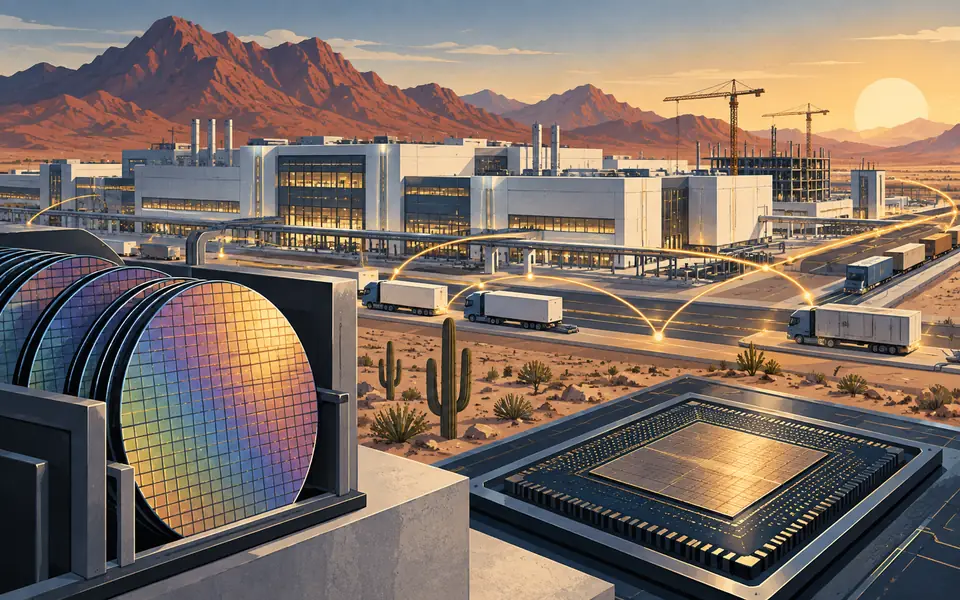
Taiwan Semiconductor Manufacturing Co. said it will invest an additional $100 billion in U.S. chipmaking, bringing its announced American commitment to $265 billion. The expansion is expected to add four advanced fabrication plants in Arizona, though the company has not provided a complete construction timetable for every facility.
The scale of that number is hard to overstate. It's more than double what most analysts expected TSMC to eventually commit to the US when the CHIPS and Science Act first passed back in 2022, and it reflects just how central American demand has become to the company's business. Roughly 78% of TSMC's second-quarter revenue this year came from North American customers alone, chief among them Apple, Nvidia, and Advanced Micro Devices, all of which depend on TSMC's most advanced chips to power everything from smartphones to AI data centers.
TSMC's competitive position
TSMC isn't just investing more, it's pulling further ahead of everyone else in the industry. The company now holds roughly 72% of the global pure-play foundry market, and at the leading edge of chip technology, its advantage is even starker. TSMC's 2nm manufacturing node is already in volume production, while its closest rivals remain at least 12 to 18 months behind on equivalent technology. That gap has helped push TSMC's market capitalization to around $1.1 trillion, making it easily the most valuable semiconductor company on Earth and one of the ten most valuable companies of any kind.
TSMC's overseas operations, including the US facilities, have also crossed an important financial threshold this year: they turned profitable in the first half of 2026 for the first time, with the Arizona operations specifically posting a 663% year-over-year profit surge. For a company that spent years absorbing losses to stand up unfamiliar manufacturing operations far from its Taiwanese base, that turnaround marks a genuine milestone, not just a symbolic one.
Intel's challenges
The contrast with Intel, once positioned as America's homegrown answer to TSMC's dominance, has only grown more pronounced. Intel Foundry Services continues to face real headwinds, with the company's overall 2026 capital spending outlook flat to declining as it restructures the foundry business. Intel's newer 18A manufacturing process has shown promise in early testing, but the company has yet to land major external customers willing to bet their chip production on it at scale, a stark difference from TSMC's already sold-out 2nm capacity.
To shore up its finances during this stretch, Intel priced a stock offering to raise roughly $19.7 billion, money the company says will help fund its transition toward the next-generation 14A manufacturing node. Whether that investment translates into the kind of customer wins needed to make Intel Foundry genuinely competitive with TSMC remains one of the more closely watched questions in the entire chip industry heading into 2027.
Why the CHIPS Act effort remains incomplete
It's worth remembering how bumpy the road to this moment has actually been. The CHIPS and Science Act, signed into law in 2022 with roughly $52.7 billion in incentives, generated enormous early optimism with a wave of announced fabs from TSMC, Intel, and Samsung. But by late 2024, those projects had run into real logistical and financial headwinds, and TSMC itself pushed back its original Arizona fab timeline by roughly a year, citing labor shortages and prolonged incentive negotiations.
Those early struggles help explain why analysts are treating this latest $100 billion commitment as more significant than a routine investment update. It suggests TSMC's calculus has shifted from cautious hedging toward genuine long-term confidence that building at scale in the US, despite the higher costs and slower ramp-up compared to Taiwan, is now worth the trade-off given how much its biggest customers value having advanced chip supply closer to home.
Implications for the semiconductor sector
Even with this expansion, Taiwan still manufactures more than 90% of the world's most advanced logic chips, and that geographic concentration isn't going away overnight regardless of how much capacity gets built stateside. But for American AI and technology companies that have spent the past few years anxious about supply chain exposure concentrated on one island in a geopolitically sensitive region, TSMC's growing US footprint represents real, if gradual, diversification — even if the chips rolling off Arizona's production lines still represent a small fraction of what the company produces globally.
Sources and further reading: Associated Press report on TSMC's expansion · NIST investment announcement
About the Author
Raj Patel
World & Technology Writer
Raj Patel writes about international affairs, science, technology, and cross-border industry. He covers diplomatic developments, emerging technology, and the global supply chains linking distant economies. His posts identify official claims and distinguish them from independently established facts, with attention to how a story is being reported differently across regions.