U.S.-Venezuela Oil Agreement Covers Rights Tied to 65 Billion Barrels of Reserves
President Donald Trump said the United States had secured majority control of interests tied to more than 65 billion barrels of Venezuelan oil reserves.

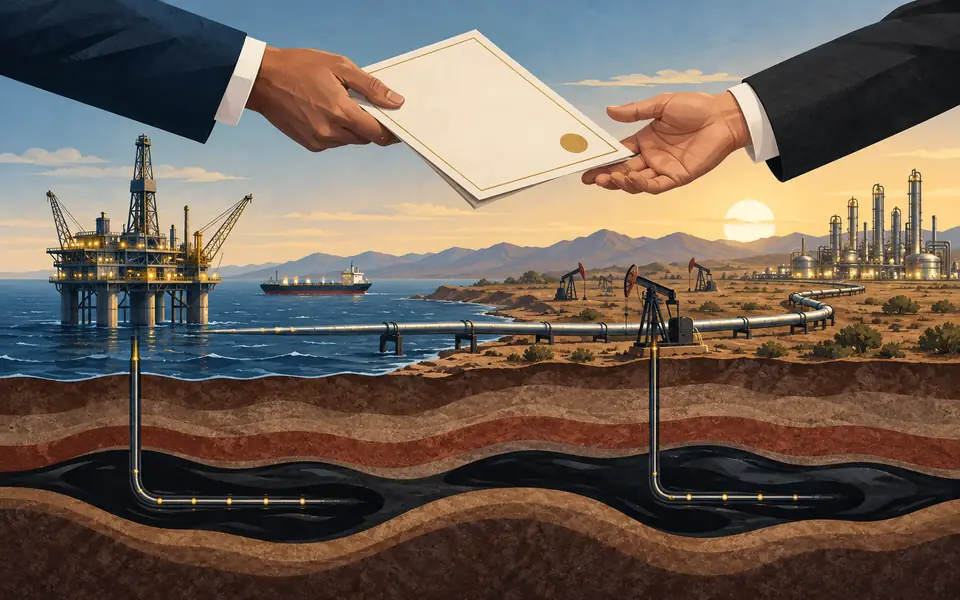
President Donald Trump said the United States had secured majority control of interests tied to more than 65 billion barrels of Venezuelan oil reserves. The figure refers to oil estimated to be in the ground, not barrels immediately available to consumers, and developing the fields would require large investments over many years.
The deal, negotiated by Secretary of State Marco Rubio and Defense Secretary Pete Hegseth alongside Venezuela's acting president Delcy Rodríguez, grants a newly formed private company a 100-year lease over oil fields holding those 65 billion barrels. The US government would hold an effective 55% stake in that company's output, according to an official familiar with the terms, along with rights to buy oil at cost — an arrangement that would make the venture the second-largest corporate holder of proven oil reserves in the world, trailing only Saudi Aramco.
Political and energy context
This deal doesn't exist in a vacuum. It arrives roughly nine months after US forces carried out a military operation in Caracas that captured then-president Nicolás Maduro and his wife, Cilia Flores, and brought them to the United States to face federal charges of narcoterrorism and drug trafficking. Both have pleaded not guilty and are set to stand trial in New York in 2027. Delcy Rodríguez has served as Venezuela's acting president since Maduro's removal, and it's her government that negotiated and signed off on the new oil arrangement.
The timing also lines up with real political pressure at home. Trump is facing mounting scrutiny over gas prices, which have climbed since the war between the US, Israel, and Iran began roughly six months ago, and with midterm elections approaching, the administration has been eager to show it's taking concrete steps to bring energy costs back down. Whether this particular deal actually delivers on that promise anytime soon is a separate question entirely.
Why additional production could take years
Venezuela sits on an estimated 303 billion barrels of proven crude reserves, roughly 17% of the world's known supply, more than any other country on Earth. But there's a catch that's been true for decades: because of chronically underfunded, deteriorating infrastructure, the country currently produces only about 1% of global oil output. Unlike other reserves around the world that still require exploration, Venezuela's oil is largely already mapped and understood — the problem has never been finding it, but pumping it out at scale.
That gap between reserves and actual production is exactly why energy analysts are cautioning against expecting a quick payoff. Much of the acreage covered by the new deal is greenfield land that typically takes seven to ten years to bring into production, while the rest consists of aging brownfield sites left to decay under the Chávez and Maduro governments, which will require billions of dollars in fresh investment before they can meaningfully add to global supply. Chevron, currently the only major US oil company still operating inside Venezuela, declined to comment on the announcement.
Implications for Venezuela and U.S. policy
For Venezuela, officials are framing the deal as a lifeline for an economy battered by years of sanctions, mismanagement, and isolation. Rodríguez said in a statement that the agreement would have a significant impact on the nation's revival, and US officials have suggested it could bring close to $100 billion in private investment into the country over time. Oil produced at cost through the new arrangement is also expected to help refill the US Strategic Petroleum Reserve and support American military fuel needs.
Beyond the barrels themselves, the deal marks a striking expansion of Washington's direct role in shaping Venezuela's economy, following a stretch of aggressive US actions in the region that included a naval blockade intercepting tankers suspected of trafficking sanctioned oil. Some analysts have compared the structure to earlier US arrangements involving sanctions relief tied to narrow legal carve-outs in Iran, though on a considerably larger scale and with the US government itself taking a more direct hand than in those earlier cases. Whether Venezuela's own legal and constitutional framework, which reserves core oil industry control for the state, ultimately allows the deal to proceed without further challenge remains an open question heading into the coming weeks.
Sources and further reading: Associated Press report on the agreement · Congressional Research Service background
About the Author
Raj Patel
World & Technology Writer
Raj Patel writes about international affairs, science, technology, and cross-border industry. He covers diplomatic developments, emerging technology, and the global supply chains linking distant economies. His posts identify official claims and distinguish them from independently established facts, with attention to how a story is being reported differently across regions.